Noida DM Medha Roopam: Wage Enforcement, School Access, and Civic Fixes on the Ground
Noida DM Medha Roopam : Since taking charge as Gautam Buddh Nagar’s first woman District Magistrate, Medha Roopam has pushed the district administration toward a noticeably more field-driven model of governance. Rather than relying on desk reviews and file-based oversight, her tenure has been marked by unannounced inspections, direct engagement with residents and workers, and […]
Nimmi Chaudhary
प्रकाशित: सोमवार, 19 अक्टूबर 2026 | 3:31 PM
पठन समय: 6 मिनट
शेयर करें:
Noida DM Medha Roopam : Since taking charge as Gautam Buddh Nagar’s first woman District Magistrate, Medha Roopam has pushed the district administration toward a noticeably more field-driven model of governance. Rather than relying on desk reviews and file-based oversight, her tenure has been marked by unannounced inspections, direct engagement with residents and workers, and a series of targeted interventions in labor compliance, education access, and civic repair.
Noida DM Medha Roopam: Wage Enforcement, School Access, and Civic Fixes on the Ground
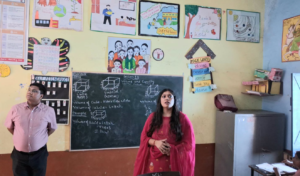
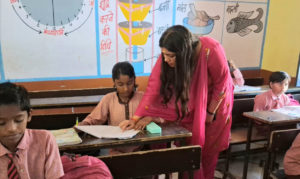
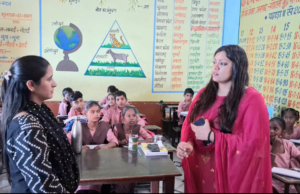
What stands out is not simply the volume of inspections, but their focus: government schools, old-age homes, industrial sectors, and construction sites where vulnerable populations are most exposed. The approach reflects a shift from reactive administration to on-the-ground problem-solving.
Worker Welfare: Enforcement With a Compliance Backbone
Following labor unrest in Noida’s industrial belt in April 2026, Roopam moved quickly to institutionalize wage protections. She convened outsourcing agencies and contractors, directing them to ensure that revised minimum wage rates—₹13,690 for unskilled workers, ₹15,059 for semi-skilled, and ₹16,868 for skilled workers—were transferred directly into workers’ bank accounts .
Her administration also warned that agencies linked to “unruly behaviour” by workers would face blacklisting and licence cancellation, a measure aimed at fixing accountability within the contractor chain . While the announcement drew criticism from opposition parties, it formed part of a broader push to formalize compliance in a sector where third-party labor arrangements often obscure responsibility.
Noida DM Medha Roopam: Wage Enforcement, School Access, and Civic Fixes on the Ground
Education Access: A Direct Intervention
In February 2026, during an inspection of preparations for a Chief Minister’s event in Greater Noida, Roopam noticed children of construction workers sitting idle at the site. She immediately ordered that the children be provided clothes and enrolled in the nearest government school, directing the Basic Shiksha Adhikari to arrange books and educational provisions .
The episode captured her operating style: identifying gaps during routine inspections and issuing on-the-spot directives rather than routing issues through lengthy administrative channels. Local residents and officials described the intervention as a reminder that access to schooling can be secured through direct administrative action .
Social Welfare: Auditing the Margins
In September 2026, DM Medha Roopam conducted a surprise inspection of the District Old Age Home in Dankaur block. Finding deficiencies in living conditions, she ordered the installation of CCTV cameras within two days, directed that water and food samples be tested, and instructed officials to link vendor payments to verifiable cleanliness standards .
She also ordered special camps to connect eligible elderly residents with state and central welfare schemes, emphasizing that no eligible person should be excluded from government benefits due to procedural complexity .
Noida DM Medha Roopam: Wage Enforcement, School Access, and Civic Fixes on the Ground
Civic Infrastructure: From Inspection to Action
Residents of Sector Beta-01 in Greater Noida had long complained of choked sewer lines, low water pressure, non-functional streetlights, and damaged electrical infrastructure. When DM Medha Roopam visited the sector in September 2026 alongside Greater Noida Authority officials and RWA representatives, she issued time-bound directives for repairs .
The response was swift: sewer cleaning and electrical repairs began the following day, with residents confirming that work had started on the issues raised during the inspection . She also directed that sewer and water lines be kept separate to protect drinking water quality, and ordered improvements to local parks, street lighting, and boundary walls .
Public Engagement and Cultural Connection
Beyond inspections and enforcement, Roopam has maintained a visible public presence. In October 2026, she inaugurated the Durga Puja Mahotsav at Greater Noida Kalibari, emphasizing that cultural events strengthen social harmony and community bonding in a district that hosts a large, diverse young population .
Her background informs this approach. A 2014-batch IAS officer and national-level shooter with three gold medals at the Kerala State Shooting Championship, she previously served as Additional Chief Executive Officer of the Greater Noida Authority, giving her direct familiarity with the region’s industrial and infrastructure landscape . She is also Noida’s first woman DM, a detail that has drawn attention to her administrative style .
Noida DM Medha Roopam: Wage Enforcement, School Access, and Civic Fixes on the Ground
A Governance Model Under Scrutiny
No administration operates without friction, and Roopam’s tenure has faced legal and political challenges, particularly around the invocation of the National Security Act following labor protests—a matter that moved through the High Court and Supreme Court. Those developments remain part of the broader context of her tenure.
But on the ground, the pattern is clear: inspections that produce immediate orders, welfare audits that target the most vulnerable, and a willingness to show up in person rather than delegate. For a district as large and complex as Gautam Buddh Nagar, that approach has delivered tangible results—from school enrollments to sewer repairs—and positioned the administration as one that measures governance by what changes on the ground.